
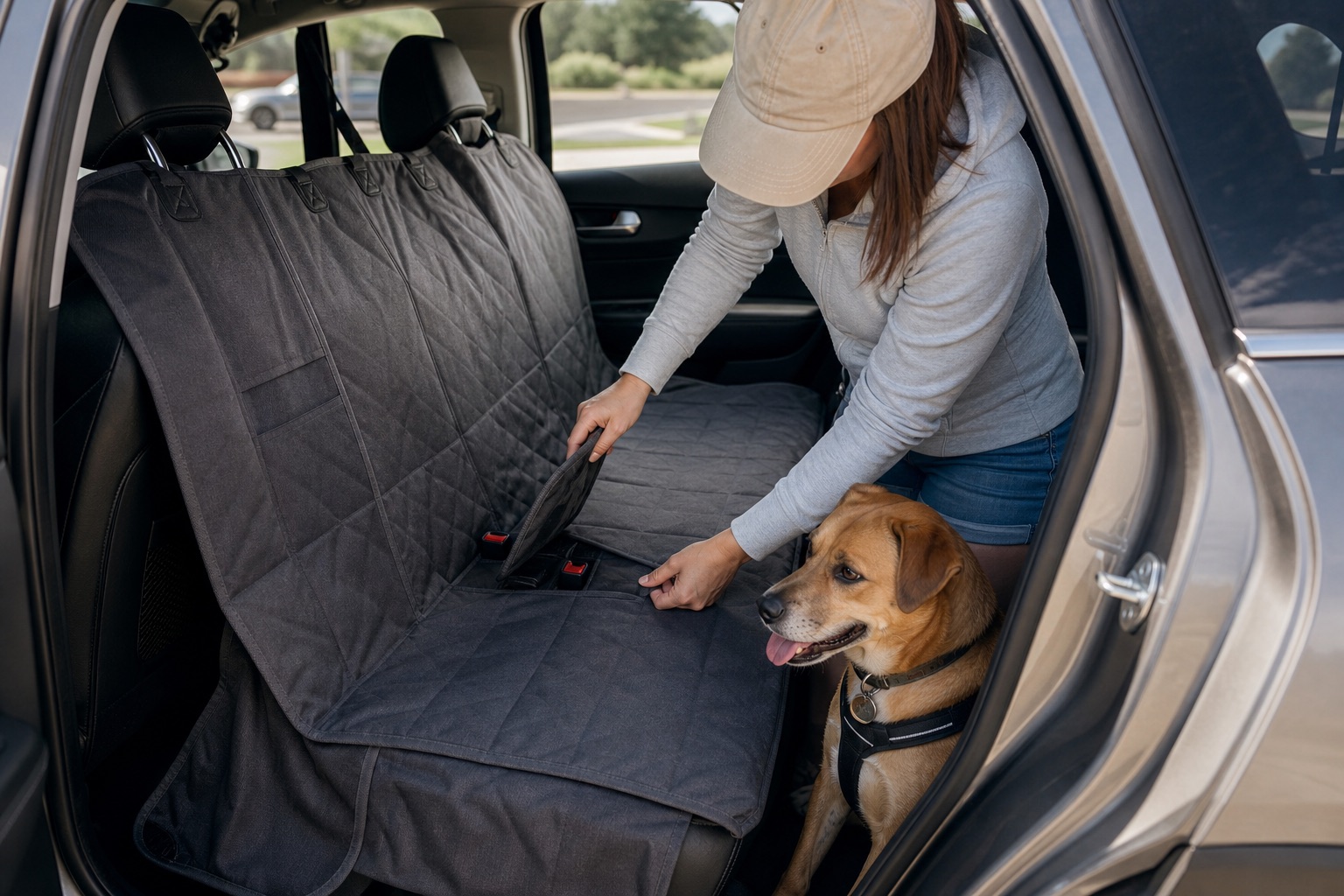
A dog car seat cover should protect your back seat without blocking the things you still need to use: seat belt buckles, child-seat anchors, a dog seat belt tether, or the middle seat belt. That sounds obvious, but it is one of the details people notice only after the cover is already installed.
For a dog owner who drives alone, a simple hammock may be fine. For a family car, a shared back seat, or a dog who wears a harness tether, seat belt access matters much more. The best cover for that situation is usually a bench cover or hammock with clearly placed hook-and-loop openings, split panels, or a design that lets one side of the seat stay usable.
This guide is based on product details, manufacturer information, and common road-trip needs. We have not personally tested every cover listed here, so treat the product notes as a buying framework, not lab results.
Quick Picks
- Best overall direction for most cars: a hammock or bench cover with hook-and-loop seat belt openings.
- Best for family cars: a split rear seat cover that keeps one seating position usable.
- Best for trucks and large SUVs: an XL cover with measured width and middle belt access.
- Best for dogs who need more floor space: a hard-bottom seat extender with belt openings.
- Best for occasional short rides: a simple bench cover with buckle slots and a non-slip backing.
Why Seat Belt Access Matters
Seat covers are usually sold as protection from fur, mud, drool, scratches, and wet paws. That is useful, but it is not the whole job. A cover that hides the seat belt buckles can make it harder to use a dog harness tether, buckle a passenger, or install a child seat correctly.
This is especially important if your dog rides in the back seat with a harness. The seat cover should let the tether reach the buckle without bunching fabric around it. If you need LATCH anchors for a child seat, read both the cover instructions and the child-seat instructions before combining them.
A seat cover also is not a restraint by itself. A hammock can reduce sliding and help protect the footwell, but it does not replace a dog harness, carrier, crate, or other restraint system.
What to Check Before You Buy
Start with the buckle openings. Look for real openings or flaps, not just a product photo that shows buckles sitting on top of the fabric. Hook-and-loop openings are common, but they should line up with your car’s buckle positions.
Next, check whether the cover works with the way your rear seat is shaped. Some covers are built for standard bench seats. Some work better with split-folding seats. Some require adjustable rear headrests. If your car has fixed headrests, bucket-style second-row seats, or an unusual seat shape, measure carefully.
Width matters too. A cover that is too narrow leaves the seat edges exposed. A cover that is too wide can bunch around the buckles. Measure the seating area from left to right, and compare it with the cover’s listed width.
Finally, think about who else uses the back seat. If you often carry a human passenger, look for a cover with a center zipper, a half-hammock option, or a split design. If the whole back seat belongs to the dog, a full hammock may be simpler.
Best for Most Cars: A Hammock With Hook-and-Loop Belt Openings
A full dog hammock is a practical choice if your dog rides across the back seat and you want extra protection for the seat back, seat bottom, and footwell area. The key is choosing one with seat belt openings that stay usable after the hammock is clipped in.
The Kurgo Rover Hammock is a good example of the type of cover to compare. Kurgo lists it as waterproof and stain resistant, with a center zipper, multiple attachment points, and hook-and-loop openings for seat belts and the latch system. The standard size is listed at 55 inches wide by 56 inches long, with an extended-width version for larger vehicles.
This style makes sense for road trips where the dog gets the back seat, but you still want access to a harness tether or a passenger belt. It is less ideal if you regularly need the whole rear bench for people.
Best for: one dog in the back seat, everyday car rides, muddy paws, and road trips where you want footwell coverage.
Not ideal for: second-row bucket seats, cars without adjustable headrests, or families who need all three rear seating positions at the same time.
Compare dog hammocks with seat belt openings on Amazon
Best for Family Cars: A Split Rear Seat Cover
If dogs and people share the back seat, a split cover is usually easier to live with than a full one-piece hammock. Split covers are designed so part of the rear seat can fold down, open up, or remain accessible without removing the entire cover.
4Knines is one brand worth comparing in this category. The company notes that its standard rear seat covers allow access to outer seat belts and LATCH anchors, while its split rear seat covers are the better direction if you need middle seat belt access. That distinction matters. Many covers show outer buckle access, but the middle buckle is where some family cars get awkward.
A split cover is also useful if you sometimes carry one passenger beside the dog. You can protect the dog’s side of the seat while leaving the other side more normal for a person.
Best for: family cars, one dog plus one passenger, split-folding rear seats, and owners who need middle belt access.
Not ideal for: buyers who want the cheapest possible cover or drivers who never use the back seat for people.
Compare split dog seat covers on Amazon
Best for Trucks and Large SUVs: An XL Cover You Measure First
Full-size trucks and large SUVs often need a wider cover than compact cars. A standard 54- or 55-inch cover may leave exposed edges, especially on broad rear benches. That does not just look messy. It gives wet paws and shedding fur a way onto the seat.
For this use case, look at XL covers and truck-specific versions. The same seat belt rule still applies: check whether the openings line up with your buckles, and check whether the product supports middle seat belt access if you need it.
Do not rely on the phrase “fits most SUVs.” Measure the actual rear seating area, especially if you drive a full-size truck, three-row SUV, or vehicle with a wide second row.
Best for: full-size trucks, large SUVs, wider rear benches, and dog owners who use the back seat often.
Not ideal for: compact cars, narrow crossovers, or cars where extra fabric will bunch around buckles.
Compare XL dog seat covers on Amazon
Best for More Dog Space: A Hard-Bottom Seat Extender With Belt Openings
A hard-bottom seat extender is different from a normal hammock. Instead of just hanging between the front and rear seats, it creates a flatter platform over the footwell. That can help a larger dog lie down more comfortably and may reduce the chance of a paw slipping into the gap.
Seat extenders can be useful for long road trips, senior dogs who want to stretch out, and dogs who do not settle well on a narrow bench. But the same caution applies: the extender should not block the buckle points you need for a harness tether or passenger belt.
Some hard-bottom covers include Velcro openings for seat belt receptacles. Check those openings before buying, and make sure the cover is compatible with your vehicle layout. Also check weight guidance and installation instructions. A platform-style cover needs to be secure enough that it does not shift when your dog changes position.
Best for: larger dogs, longer road trips, senior dogs, and owners who want a flatter back-seat area.
Not ideal for: cars where passengers frequently need the rear footwell or dogs who chew fabric and panels.
Compare hard-bottom dog seat extenders on Amazon
Best Simple Option: A Bench Cover With Buckle Slots
Not every dog needs a full hammock. For calm dogs, short drives, and cars where you mostly want fur and dirt protection, a bench cover can be enough. Bench covers are easier to install, easier for passengers to use, and less likely to make the back seat feel closed off.
The trade-off is less footwell coverage. If your dog slides forward during hard braking, a bench cover alone will not stop that. Pair it with an appropriate restraint, and choose a cover with a non-slip backing, seat anchors, and buckle slots that remain open after installation.
Bench covers are also easier to remove and shake out. That matters if your dog rides in the car every day and the cover gets covered in hair quickly.
Best for: short rides, calmer dogs, shared back seats, and owners who want a simple setup.
Not ideal for: dogs who move around a lot, heavy mud, beach trips, or drivers who want footwell protection.
Compare bench dog seat covers on Amazon
Seat Belt Access Checklist
Before buying, check:
- Does the cover have openings for the seat belt buckles?
- Are the openings hook-and-loop, zipper, slit-style, or split-panel?
- Can you reach the buckle while the cover is fully installed?
- Does it allow outer seat belt access only, or middle seat belt access too?
- Does it mention LATCH anchor access?
- Does your vehicle have adjustable headrests for the straps?
- Will a human passenger ever sit beside the dog?
- Does your dog use a harness tether, carrier, or crate?
- Will extra fabric bunch around the buckle?
- Can the cover be removed and cleaned easily?
If a listing does not show the buckle area clearly, keep looking. Product photos often show the dog and the quilted surface, but the buckle openings are the detail that determines whether the cover works in real life.
Common Mistakes
One common mistake is buying by seat width alone. Width matters, but a well-sized cover can still be frustrating if the buckle openings do not line up.
Another mistake is assuming a hammock makes the car ride safe by itself. It helps with coverage and containment, but your dog still needs an appropriate restraint or secured travel setup.
A third mistake is ignoring the middle seat belt. Many owners only need the outer buckles. Families, rideshares, and people who carry passengers may need the center position too.
Finally, do not assume every “waterproof” cover is fully watertight at seams and openings. Seat belt slits, stitching, and hook-and-loop areas can be weak points. If your dog swims, hikes in rain, or gets carsick, keep an old towel or washable liner in the car.
Final Thoughts
For most dog owners, the best dog car seat cover with seat belt access is not the thickest or the most expensive one. It is the one that fits your actual back seat, leaves the buckles usable, and matches the way your dog rides.
If your dog gets the full back seat, start with a hammock that has clear belt and latch openings. If people and dogs share the row, look harder at split covers or simple bench covers. If your dog needs more room to lie down, compare hard-bottom extenders, but check the buckle access carefully before buying.
The goal is a back seat that is easier to clean without making the car harder or less safe to use.
FAQ
Can I use a dog seat belt with a car seat cover?
Yes, if the cover leaves the seat belt buckle accessible and the tether can reach without twisting or bunching the fabric. Always attach the tether to a properly fitted dog harness, not a regular collar.
Do dog hammocks have seat belt openings?
Some do, some do not. Look for hook-and-loop openings, buckle slots, or product photos that clearly show the rear seat belt buckles accessible after installation.
Is a dog seat cover the same as a restraint?
No. A seat cover protects the car and may reduce sliding, but it does not replace a harness, carrier, crate, or other restraint setup.
What if I need the middle seat belt?
Look for a split rear seat cover or a product that specifically mentions middle seat belt access. Many covers only make the outer buckles easy to reach.
Are dog seat covers safe with child car seats?
Do not guess. Read the child-seat manual, vehicle manual, and seat cover instructions. Some covers mention LATCH access, but that does not automatically mean every child-seat setup is approved.