
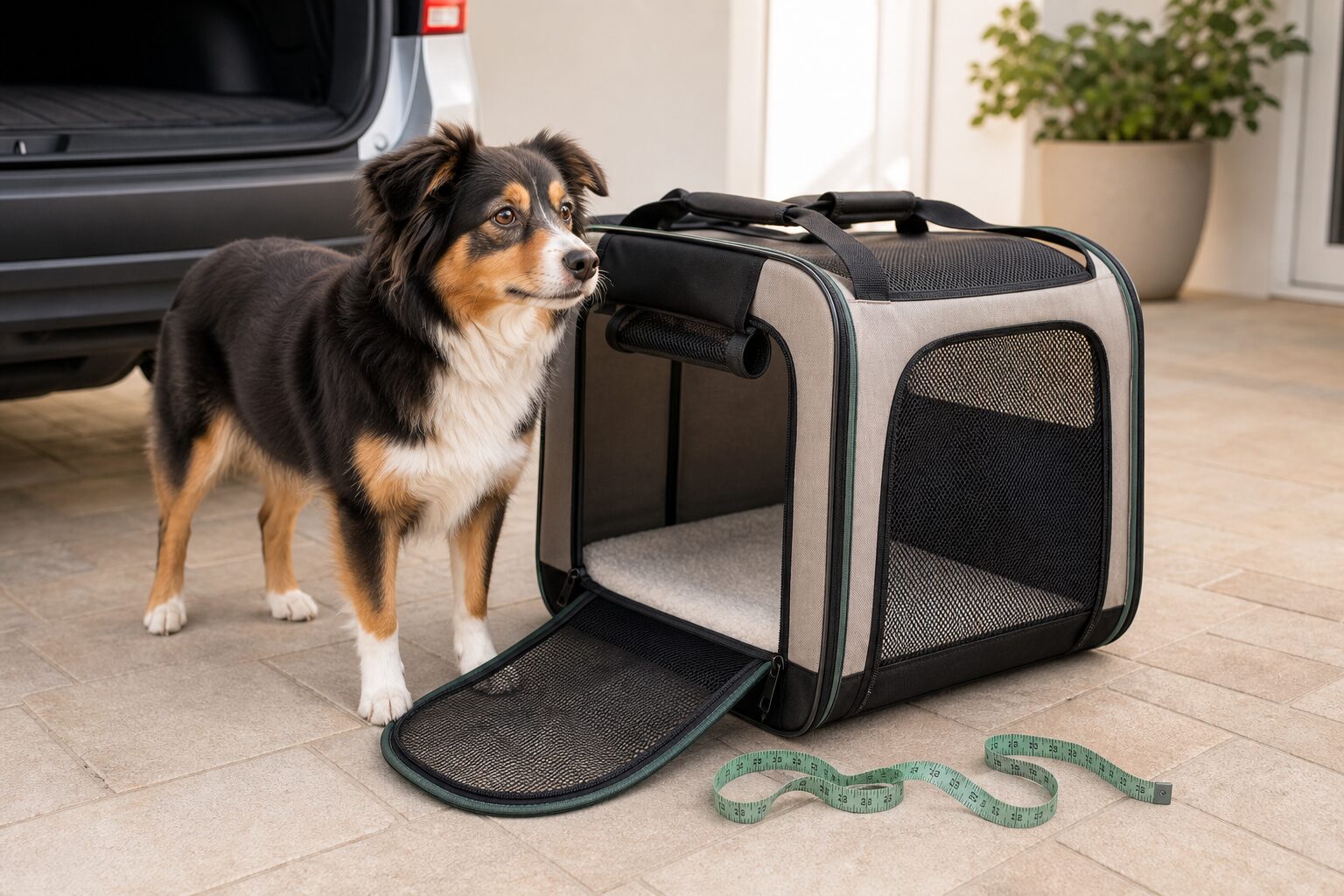
A dog carrier should not feel like a tight bag with handles. It should give your dog enough room to stand, turn around, lie down, and breathe comfortably while still being secure enough for travel.
The right size depends on more than your dog’s weight. Length, height, body shape, anxiety level, trip length, and the way you plan to use the carrier all matter.
The Short Answer
To choose the right dog carrier size, measure your dog from nose to tail base and from floor to shoulder or head, then compare those measurements with the carrier’s interior dimensions. Your dog should be able to turn around and rest naturally without being squeezed into the sides.
Do not rely only on weight ranges. A long, low dog and a compact dog can weigh the same but need very different carrier shapes.
Measure Your Dog Before Shopping
Use a soft measuring tape if you have one. If your dog will not stand still, take a few measurements while your dog is relaxed and use the largest reasonable number.
Length
Measure from the tip of the nose to the base of the tail. You do not need to include the full tail, but you should include your dog’s body length when standing naturally.
Height
Measure from the floor to the top of the shoulders. For dogs with tall ears or dogs who sit upright in carriers, also consider head height. A carrier that is technically tall enough at the shoulder may still feel cramped if your dog cannot raise their head comfortably.
Width and Body Shape
Some dogs are narrow and compact. Others are broad-chested, long-backed, or stocky. If your dog has a wide chest or thick coat, leave more room than the minimum size chart suggests.
Check Interior Dimensions, Not Just Product Labels
Many carriers are sold with weight labels like small, medium, or up to 20 pounds. Those labels are only a starting point.
Look for the interior length, width, and height. If a listing only gives outside dimensions, the usable space may be smaller because of padding, seams, wheels, pockets, or a structured frame.
For soft-sided carriers, check whether the sides sag inward. For hard carriers, check whether the door opening is large enough for your dog to enter without scraping their back or shoulders.
Match the Carrier to the Trip
Short Car Rides
For short car rides, comfort and stability matter most. The carrier should sit flat in your vehicle and should not slide around. A little extra room can help your dog settle, especially if they are not used to enclosed spaces.
Vet Visits and Everyday Errands
For quick errands, a lightweight carrier may be enough for a small dog. Look for easy entry, good handles, and enough ventilation. If your dog resists going into carriers, a top-loading design can be easier than pushing your dog through a narrow front door.
Flights
Airline travel has stricter size limits, and those rules can change by airline, route, aircraft, and seat type. Always check the airline’s current pet carrier rules before booking or buying a carrier for a flight.
For cabin travel, many soft carriers are designed to fit under a seat, but your dog still needs to fit comfortably inside. Do not choose a carrier that only fits the plane but does not fit your dog.
Signs a Carrier Is Too Small
- Your dog cannot turn around
- Your dog’s back presses into the top
- Your dog curls awkwardly instead of resting naturally
- The sides bulge when your dog lies down
- Your dog pants, paws, or freezes every time they are inside
Some dogs dislike carriers at first even when the size is correct. But if your dog physically cannot change position, the carrier is too small.
Signs a Carrier May Be Too Large
Too large is less common, but it can still be a problem in the car. A carrier with too much empty space may let your dog slide during turns or sudden stops.
For car use, the carrier should be roomy enough for comfort but stable enough that your dog is not moving around inside like loose luggage.
Comfort Details Worth Checking
Size is the first filter, but not the only one. Before choosing a dog carrier, check:
- Ventilation on at least two sides
- A washable or removable mat
- Zippers or latches that feel secure
- A stable bottom that does not collapse under your dog
- Entry points that match your dog’s temperament
- Handles or straps that are comfortable for you to carry
A carrier that fits your dog but is awkward for you to lift will not be pleasant on a long travel day.
Final Thoughts
The best carrier size is the one that fits your actual dog, not just the number on a product chart. Measure first, check interior dimensions, think about the type of trip, and leave enough room for natural movement.
If you are between sizes, choose based on how the carrier will be used. For relaxed car travel, a little extra room is usually helpful. For airline cabin travel, you need to balance your dog’s comfort with the airline’s current size rules.
FAQ
How much room should a dog have in a carrier?
Your dog should be able to stand, turn around, and lie down comfortably. The carrier should not press into your dog’s back, shoulders, or sides.
Can I choose a dog carrier by weight?
Weight is only a starting point. Always compare your dog’s length and height with the carrier’s interior dimensions.
Is a soft or hard carrier better?
Soft carriers are often easier for small dogs and cabin-style travel. Hard carriers can offer more structure for some car trips and crate-style use. The better choice depends on your dog and your trip.
Should I size up for an anxious dog?
A little extra room can help some dogs, but too much space may feel unstable in the car. Comfort, ventilation, and gradual carrier training matter as much as size.